Researchers have described in detail the very beginning of plant endocytosis—one of the most important processes that allows cells to take in substances from the surrounding environment.
The study was a collaboration between scientists from the Institute of Experimental Botany of the Czech Academy of Sciences, the Faculty of Science at Charles University, and several Belgian institutions. The discovery, published in the journal Nature Plants, may help with more precise control of plant cell division and the breeding of agricultural crops in the future.
Plant cells function much like a small logistics center—they constantly receive and sort substances necessary for growth and communication. Endocytosis is a process by which tiny vesicles carrying various substances detach from the cell surface and move inward. This mechanism is essential for the uptake of certain nutrients and hormones, the regulation of cell division, and the maintenance of proper membrane function.
The first phase of endocytosis, which the team has now described in detail, is the curvature—the inward folding—of a small area of the surface membrane into the cell. A microscopic vesicle eventually forms from the membrane in this location, detaches and travels with its “cargo” to its destination.
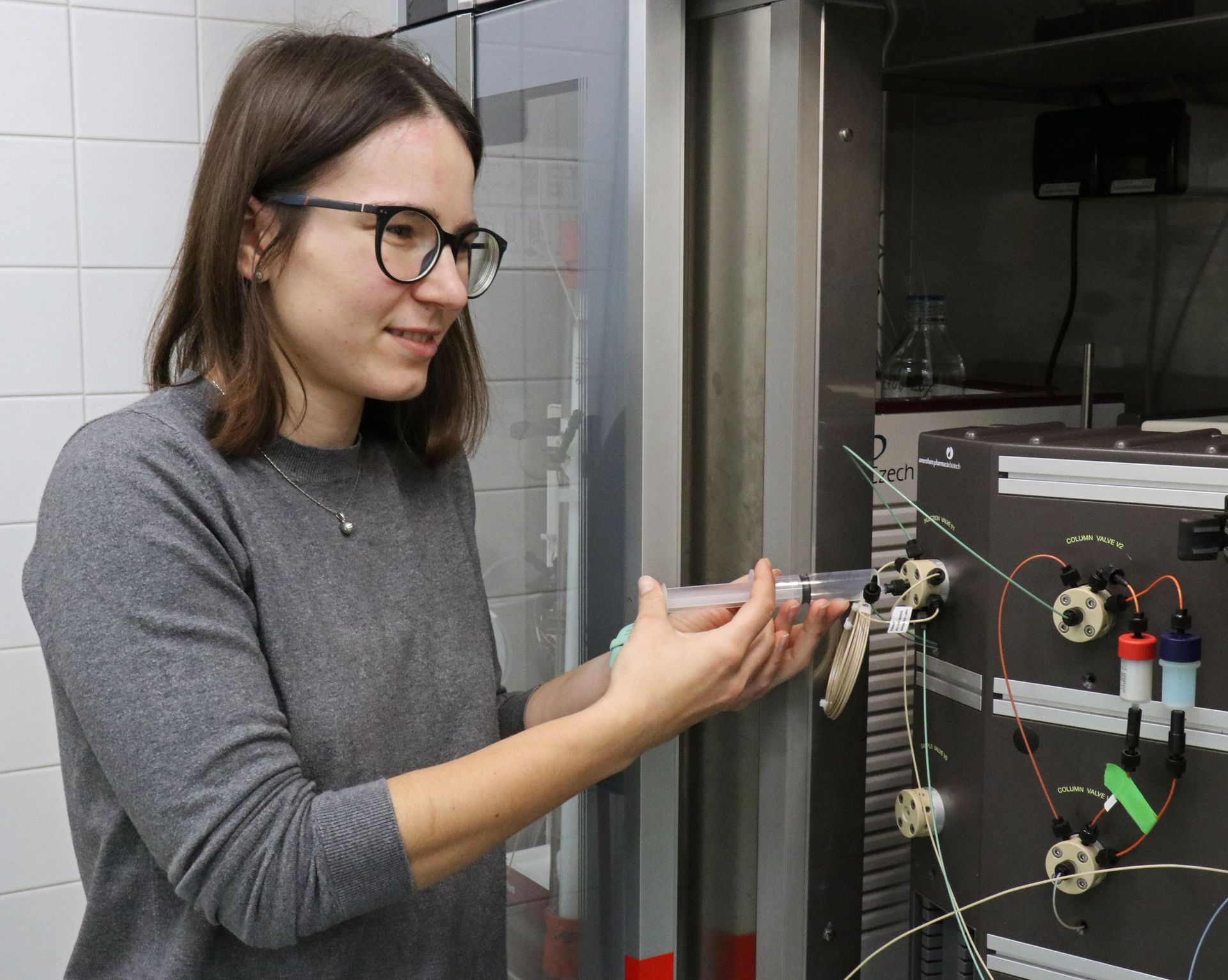
Research co-author Michaela Neubergerová next to an instrument for the separation and purification of studied proteins
How the cell initiates its transport processes
A Belgian-Czech team led by Daniël Van Damme of the VIB Center for Plant Systems Biology and Ghent University and Roman Pleskot of the Institute of Experimental Botany of the Czech Academy of Sciences (IEB CAS) combined experiments and computational simulations to investigate how the TPLATE protein complex triggers the first phase of endocytosis.
“Some time ago, we already demonstrated that the complex is necessary for membrane curvature at the cell surface. Now we have discovered how it likely does this,” explains Roman Pleskot from the IEB CAS.
“First, we created a detailed model of the TPLATE complex’s structure. The structure provides us with a wealth of information about the molecules’ functions—it’s like closely inspecting a bicycle, from which you can easily understand how it works and what it’s used for,” he adds.
It turned out that the TPLATE complex consists of two distinct parts. Simply put, one part has a rigid structure, while the other can flexibly change shape.
Mathematical simulations of molecular interactions between the complex and the membrane confirmed that endocytosis begins when the deformable parts of at least two complexes meet on the membrane surface. Only their mutual cooperation with the more rigid parts allows the formation of a characteristic invagination, from which a transport vesicle subsequently separates.
“Simulations of processes at the molecular level serve as a ‘computational microscope’ for us. Thanks to it, we can see more than we would with even the best physical microscope.”
“The interplay between experimental and computational approaches to the problem is also essential. We can verify experimental results with simulations and vice versa, which streamlines our work and allows us to address even very complex questions,” says co-author Michaela Neubergerová, a PhD student at the Faculty of Science, Charles University, who also works in Roman Pleskot’s laboratory at the IEB CAS.
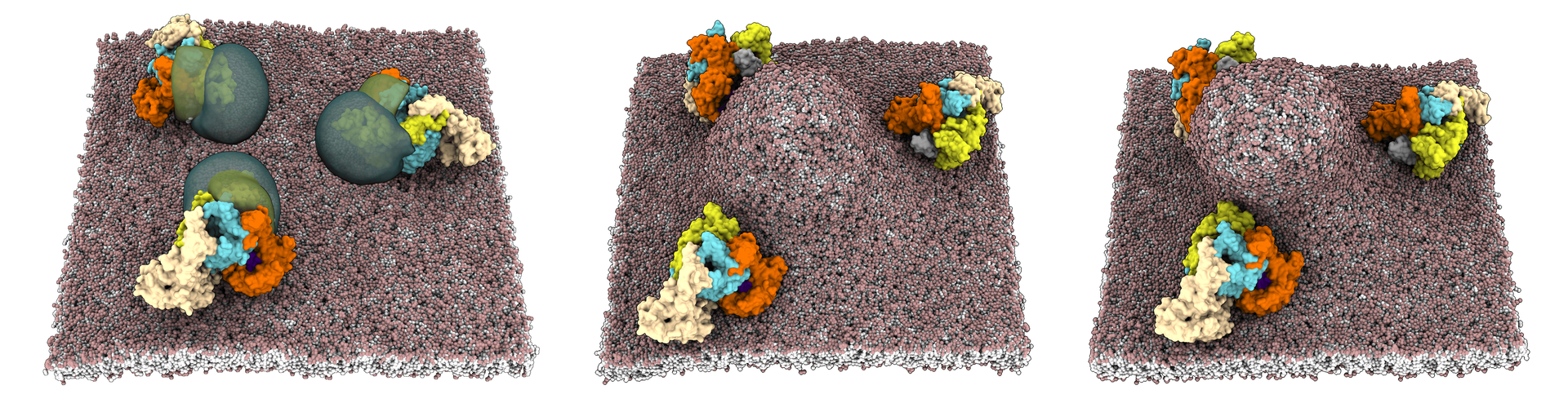
Computational simulation of membrane curvature. The first image (left) shows three TPLATE complexes on the surface of the cell membrane. Lighter and darker shades of green indicate the flexible part of the complex, while other colors indicate the part with a more rigid structure. Through their interaction, an invagination gradually forms, from which a transport vesicle eventually detaches. The flexible part was removed in the second and third images for simplicity. Author: Michaela Neubergerová.
Implications for research and evolution
In 2022, Roman Pleskot received the prestigious five-year Junior STAR grant, designed for young scientists to establish their own research groups. His team’s main focus is now on the processes involved in plant cell division—including endocytosis.
“Once we understand the molecular mechanisms in detail, we will be able to precisely regulate cell division. This is also important for breeding better crop varieties. The project’s results open up various possibilities for further research—we can investigate other phases of endocytosis and its evolution,” adds Roman Pleskot.
The TPLATE complex is an evolutionarily ancient solution that is absent in animals and yeasts, where endocytosis proceeds differently. Understanding the interaction between the rigid and flexible parts of the complex thus provides broader insight into the functioning of vital cellular processes.
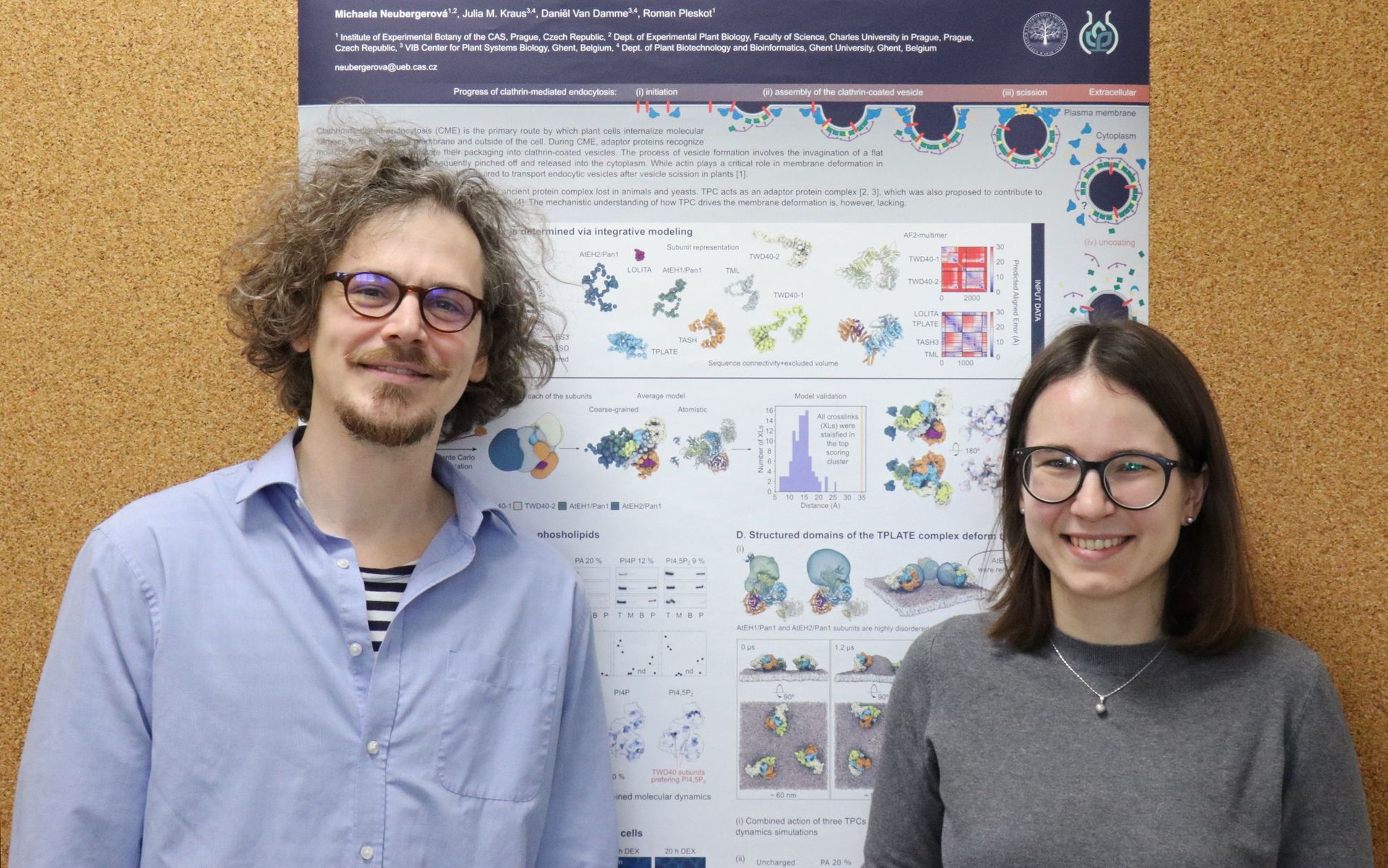
Roman Pleskot and Michaela Neubergerová in front of a poster describing their research
* * *
Link to the article:
Kraus JM, et al. (2025): A combined biochemical and computational approach provides evidence for membrane remodelling by the structural scaffold of the endocytic TPLATE complex. Nature Plants 11: 2423-2436.
https://doi.org/10.1038/s41477-025-02146-y
(paywall)