An international team, including our scientists, created plants that glow in the dark. The light intensity indicates the levels of two hormones crucial to plants’ responses to pathogens and pests.
The project’s results were published in the renowned journal Nature Communications.
Some organisms possess the fascinating ability to produce light. You are surely familiar with fireflies from nature. And perhaps you have seen glowing stumps in a nighttime forest, where the impressive light effects are caused by the mycelium of wood-decaying fungi. Many marine fish, invertebrates, and protozoa also glow. Some fish, especially deep-sea species, even utilize the services of luminescent bacteria with which they live in symbiosis.
The production of light by living organisms is technically called bioluminescence. It is based on specific chemical reactions in which energy is released in the form of light. Two main ingredients are needed for bioluminescence: the organic compound luciferin and the enzyme luciferase, which catalyzes the reaction of luciferin with oxygen to produce light. Different groups of organisms use their own luciferins and luciferases.
Genes from a fungus lit up a plant
About ten years ago, Russian scientists elucidated the molecular details of bioluminescence in the tropical fungus Neonothopanus nambi. They identified its genes for luciferase as well as for the enzymes responsible for luciferin synthesis.
They subsequently succeeded in transferring these genes into the tobacco species Nicotiana benthamiana, thereby creating “glowing” plants. The research was led primarily by teams headed by Ilya Yampolsky and Karen Sarkisian, who is now based in London.
In 2019, Jan Petrášek, head of our Laboratory of Hormonal Regulations in Plants, was contacted by the Russian researchers. They were intrigued by the possibility of using bioluminescence to study plant hormones. Since 2021, Michael Karampelias has been leading this research in the laboratory.
“The collaboration began even before the Russian invasion of Ukraine in 2022. The war practically brought it to a complete halt, so our team is now continuing more or less independently,” he says.
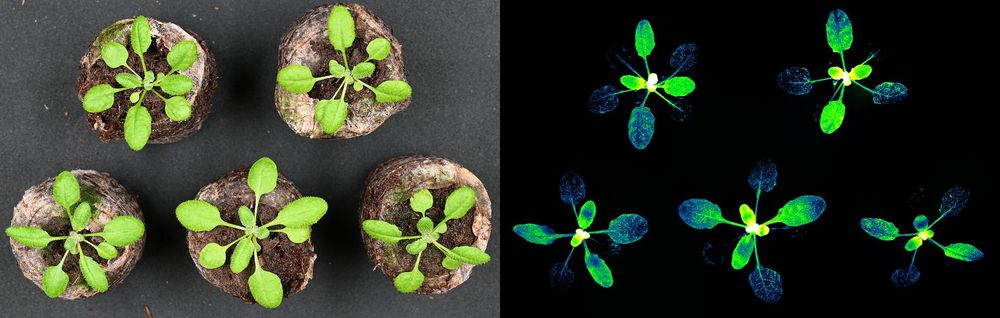
Young Arabidopsis thaliana plants under normal lighting (left) and their bioluminescence in darkness (right). In the plants shown here, the gene for luciferase—the enzyme responsible for light production—is constantly active regardless of hormone levels.
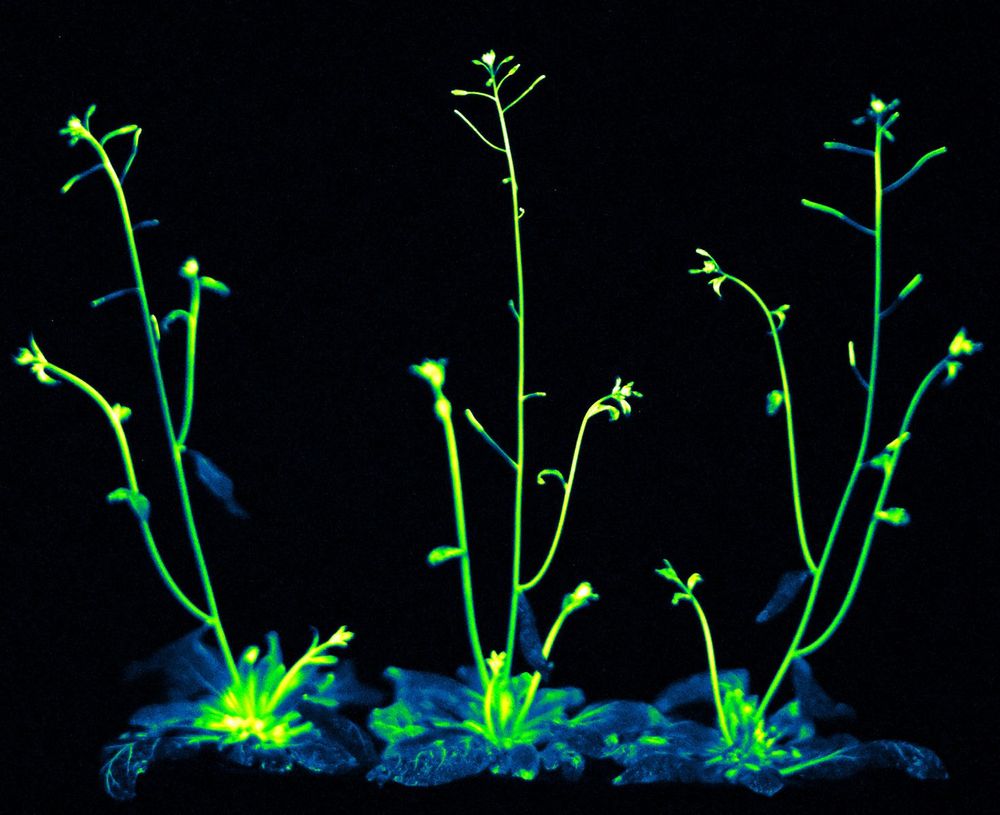
Bioluminescence of older Arabidopsis plants that are already flowering and producing fruits. In these plants, the luciferase gene is also continuously active in all their organs.
Let’s shine a light on hormones
A recent article in Nature Communications summarizes the results of work by scientists from our institute and several institutions in Russia, the UK, and the US. The goal was to create experimental plants functioning as “glowing reporters”: the intensity of their bioluminescence would be proportional to the levels of salicylic acid or jasmonic acid in the cells.
These two substances are hormones that control plants’ responses to attacks by disease-causing agents (pathogens) and pests. Biologists are therefore very interested in when and where these hormones accumulate in an infected plant to coordinate its defense.
The scientists linked the luciferase gene to a regulatory DNA segment that is sensitive to the concentration of the relevant hormone. Based on this, it controls the activity of the luciferase gene—and thus also light production.
The result was tobacco plants Nicotiana benthamiana and Arabidopsis thaliana, whose bioluminescence reflects the levels of salicylic or jasmonic acid in various organs and their parts. Both hormones responded to pathogen infection or feeding by insect pests in the manner already known from previous research. The researchers thus confirmed the reliability of their new method.
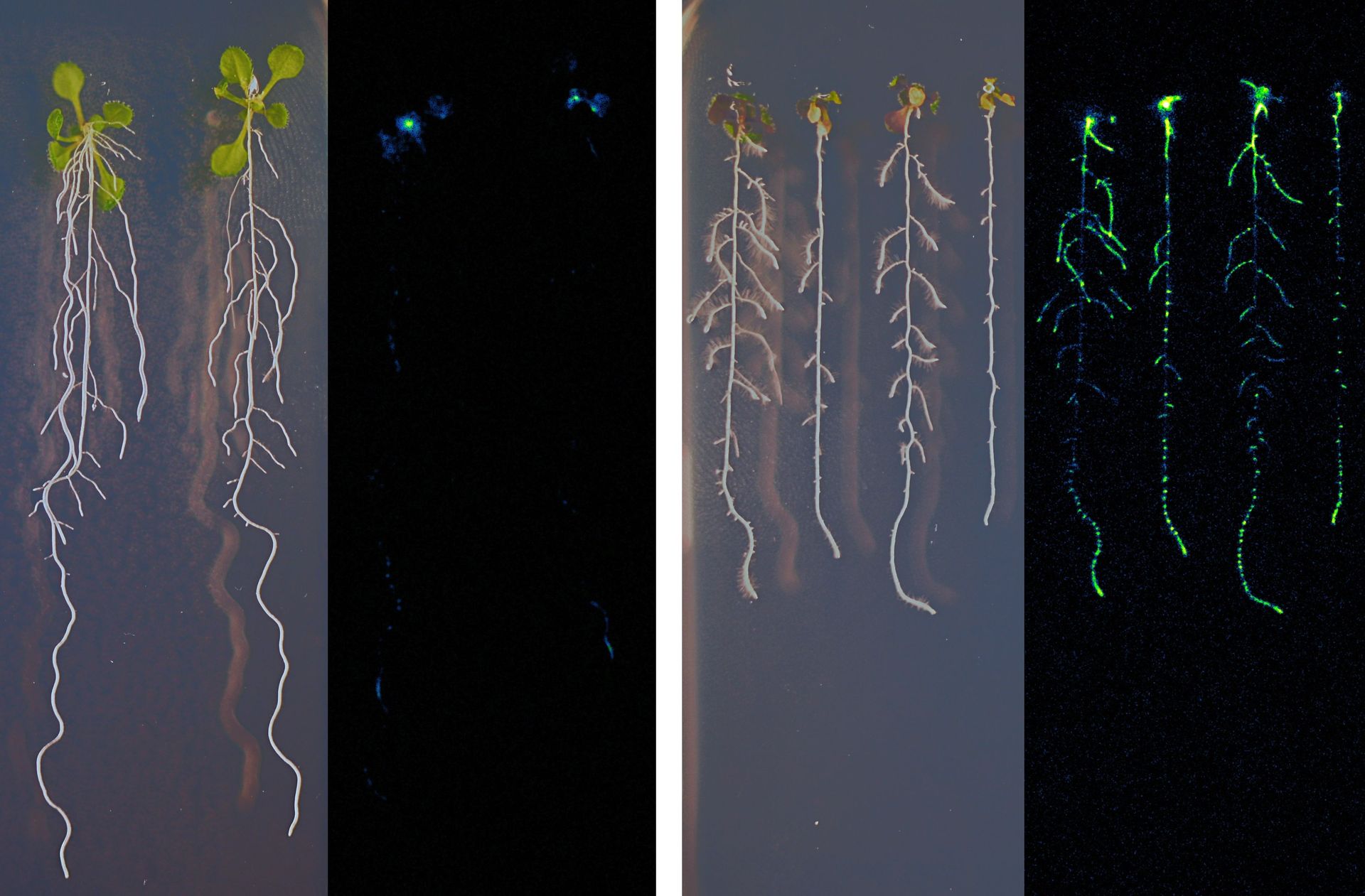
Arabidopsis seedlings genetically modified so that their bioluminescence is proportional to the concentration of jasmonic acid in their cells. The left half of the image shows healthy plants under normal lighting conditions and their bioluminescence in darkness. In the right half, you can see plants infected with the bacterium Pseudomonas syringae. It is clearly visible that jasmonic acid levels rise significantly following pathogen infection.
Wide-ranging possibilities for research and applications
“Our team at the Institute of Experimental Botany of the CAS was tasked with transferring the entire bioluminescent system into Arabidopsis thaliana, that is, integrating all the necessary genes into its DNA. We actually succeeded in doing so. Since Arabidopsis is the most commonly used model plant today, this has opened up a wide range of applications,” says Michael Karampelias.
The glowing Arabidopsis, which is sensitive to salicylic or jasmonic acid, is an excellent tool for studying plant defenses against diseases and pests. A better understanding of these mechanisms may help breed more resilient crop varieties in the future and reduce pesticide use.
Michael Karampelias, however, is aiming even further. He is now working with colleagues on plants that would detect concentrations of other important hormones in the same way—hormones responsible for growth and development as well as for responses to various external stimuli.
Plant hormone concentrations can also be visualized using a second light-based method—so-called fluorescence. It is mainly used in microscopy, where it is already well-established and well-developed. So why bother with bioluminescence as well?
“In my opinion, the two methods complement each other perfectly. Fluorescence techniques provide detailed information down to the level of cells or intracellular structures. However, a microscope can only be used to examine small plants, such as seedlings, and only for a limited time.”
“Bioluminescence is less suitable for microscopy—at least for now. On the other hand, it is completely non-invasive and allows us to study plants grown under more natural conditions, such as in soil. Using standard digital cameras, we can even capture images of larger plants continuously for many weeks. We could, for example, track changes in hormone levels during the complete individual development, from germination to senescence,” explains Michael Karampelias.
The advantage of bioluminescence is that it enables long-term monitoring of experimental plants. This time-lapse video captures the life of Arabidopsis thaliana from seed sowing until the age of 17 days. In this plant, the luciferase gene was again continuously active. All photographs and video were made by Michael Karampelias.
Link to the article:
Balakireva AV, et al. (2026): Non-invasive imaging of defence responses in plants. Nature Communications 17: 6393.
https://doi.org/10.1038/s41467-026-70075-1
(open access)