Phloem sieve elements undergo a radical transformation to perform their function—distributing sugars and other substances across the plant. However, it was unclear what completes this transformation.
A team led by Adriana Jelínková from our Laboratory of Hormonal Regulations in Plants was the first in the world to describe these processes in detail. Other researchers from this laboratory, the BIOCEV research center, and Professor Hardtke’s group at the University of Lausanne in Switzerland contributed to the research. Light microscopy in this study was performed at the Imaging Facility IEB using plant-optimised microscopy equipment.
The research findings were published in the renowned scientific journal Current Biology.
In plants, the so-called vascular tissues serve as the equivalent of the human circulatory system. The xylem ensures the flow of water and minerals from the roots to other organs. The phloem, on the other hand, primarily transports sugars from green parts of the plant—where they are produced by photosynthesis—to non-green parts, such as the roots.
In angiosperms—that is, flowering plants—this “long-distance freight transport” is carried out by long tubes that form during the plant’s development through the fusion of originally separate, undifferentiated cells. In the xylem, these tubes are called vessels; in the phloem, they are called sieve tubes.
Vessels are composed of dead cells, of which only the cell walls remain. In contrast, the basic structural units of sieve tubes—known as phloem sieve elements—are cells that exist in a peculiar “zombie” state. At the end of their development, they lose a large portion of their cellular contents, including the nucleus, but retain not only the cell wall but also a portion of the cytoplasm and certain membrane structures.
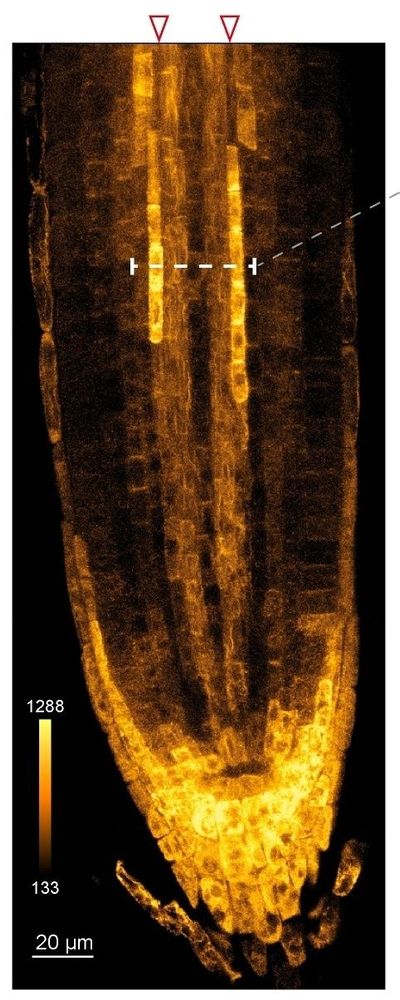
A longitudinal section of the arabidopsis root tip. The actin filaments are colored gold. They are particularly prominent in the developing phloem sieve elements (two vertical strands of cells in the upper half of the image, indicated by arrows).
Where does it all go?
Until now, biologists believed that phloem sieve elements dispose of their contents exclusively through a process called autophagy, in which intracellular structures are broken down by enzymes. The breakdown of DNA and the disappearance of the cell nucleus were thought to be the final step in the development (differentiation) of these cells into fully functional sieve tubes.
However, the authors of the study published in Current Biology found that this notion is incorrect. Using state-of-the-art microscopes, they observed the developing phloem in roots of the experimental plant Arabidopsis thaliana. They first focused on filaments of a protein called actin, which form a sort of network inside the cell that controls, for example, the transport of various substances. And they discovered something very surprising.
“In the differentiating phloem sieve elements, there was a large amount of actin filaments, which, however, suddenly disappeared. As further observations revealed, at the end of their development the sieve elements pushed them out into neighboring cells—along with a part of their cellular contents. The speed of this process was striking because it took only about five minutes,” explains the study’s lead author, Adriana Jelínková.
Subsequent experiments with living roots and their microscopic preparations painted a complete picture that differs significantly from plant biologists’ previous assumptions. So what do the final developmental stages look like for the cells that will become phloem sieve elements?
• Enzymes begin to break down the nucleus and other cellular contents through a process called autophagy.
• The disintegrated remnants of the nucleus are expelled into neighboring cells.
• A few minutes later, the cell disposes of other, selectively chosen parts of its original contents in the same manner. At roughly the same time, membrane structures form inside the cell, and these are preserved even in fully developed phloem sieve elements.
• The cell becomes a functional sieve element. It begins to transport sugars and other organic substances.

Development of phloem sieve elements in the arabidopsis root. From left to right, you can see cells at various stages of differentiation (PSE-8 to PSE-1), which culminates in a mature phloem sieve element (PSE). Actin filaments are labeled gold, cell walls white. The mature element has a thickened cell wall and lacks actin filaments.
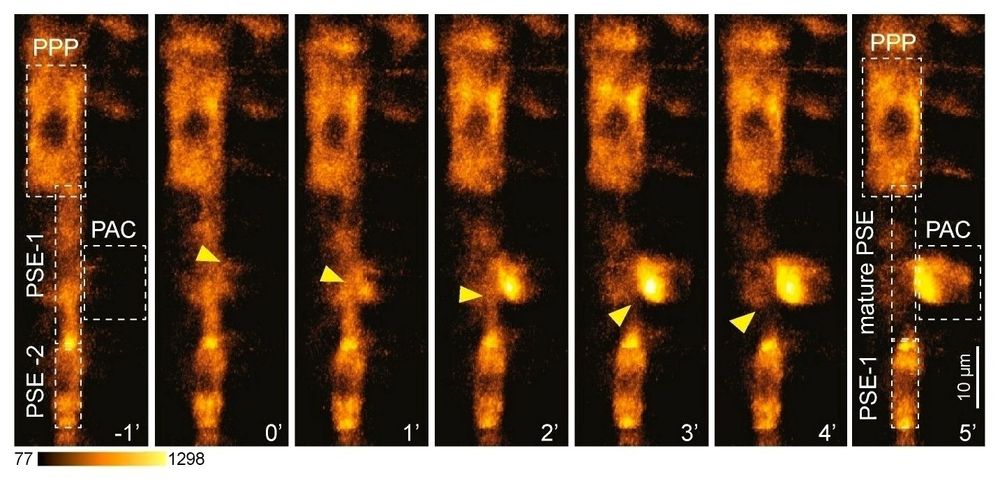
A time-lapse sequence showing the expulsion of cellular contents from a developing phloem sieve element (PSE) into an adjacent cell (PAC); indicated by a yellow arrow. Actin filaments are labeled gold. The time in minutes since the start of the process is shown in the lower right corner of each image.
New discoveries raise new questions
Breakthrough studies often open up new, previously unimagined possibilities for future research. This is also the case here.
“We do not yet know the exact mechanism by which the contents of future phloem sieve elements move into neighboring cells. Another interesting question is whether this transferred material has any effect on the development or function of the cells where it ends up. We also want to investigate how phloem differentiation is related to plant hormones, particularly brassinosteroids, auxin, and cytokinins,” says Adriana Jelínková.
“What remains in mature sieve tubes is also worthy of further research, especially the remodeled internal membrane structures discovered by our co-authors at BIOCEV. It appears that these are important for the tubes‘ proper functioning,” she adds.
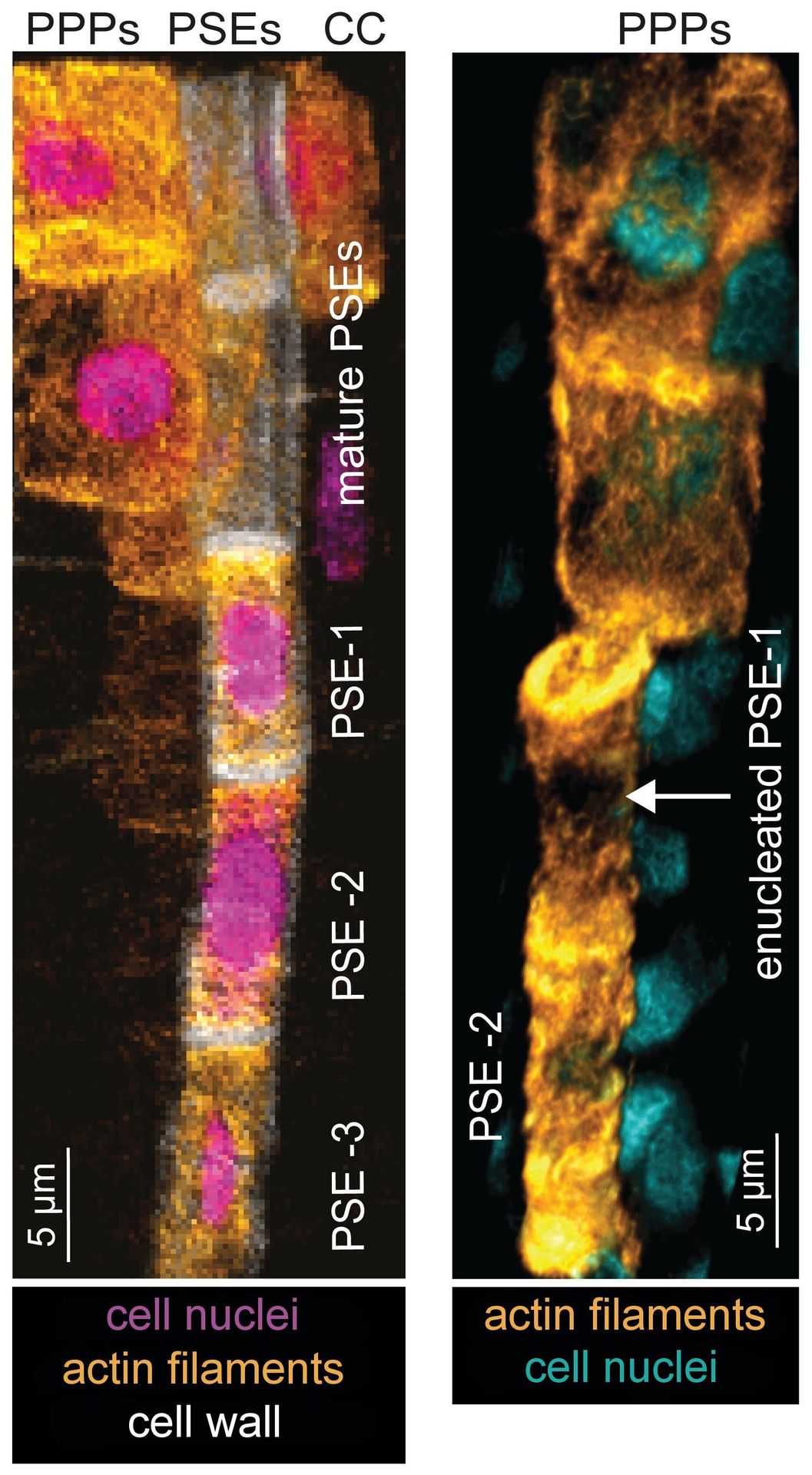
A close-up of developing phloem sieve elements (PSE) alongside neighboring phloem cells (PPP, CC). The phloem sieve elements at the top of the images are the most developmentally advanced. The image on the left shows that mature PSEs lack both actin filaments and cell nuclei. The image on the right demonstrates that in future phloem sieve elements, the nucleus disappears first (enucleated PSE-0, white arrow), followed later by the actin filaments.
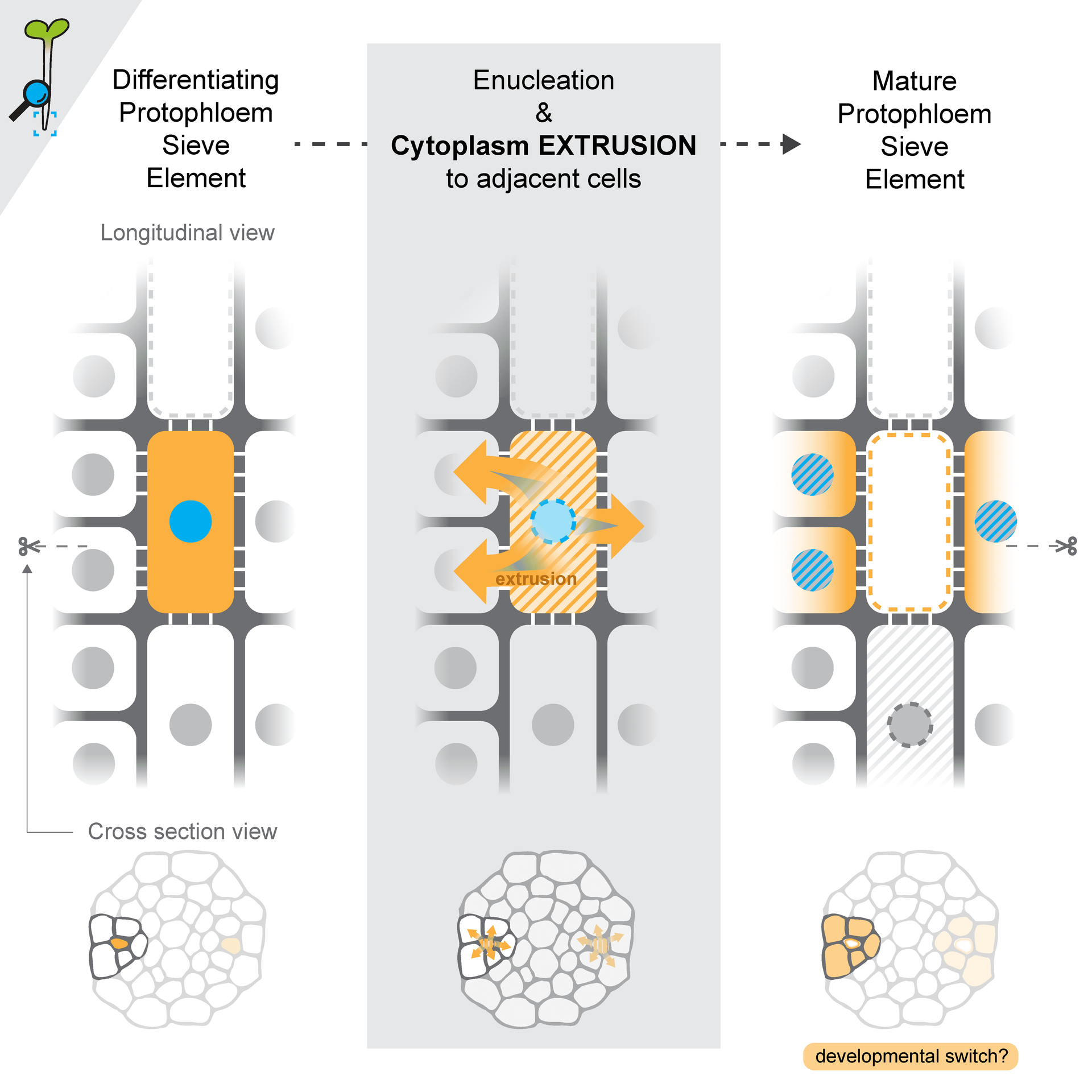
Graphic summary of the paper. For all images in the text, source: authors of the article in Current Biology, license: Creative Commons CC-BY.
Link to the article:
Jelínková A, et al. (2026): Rapid cell-to-cell expulsion completes phloem sieve element maturation. Current Biology 36: 1–11.
https://doi.org/10.1016/j.cub.2026.06.042
(open access)